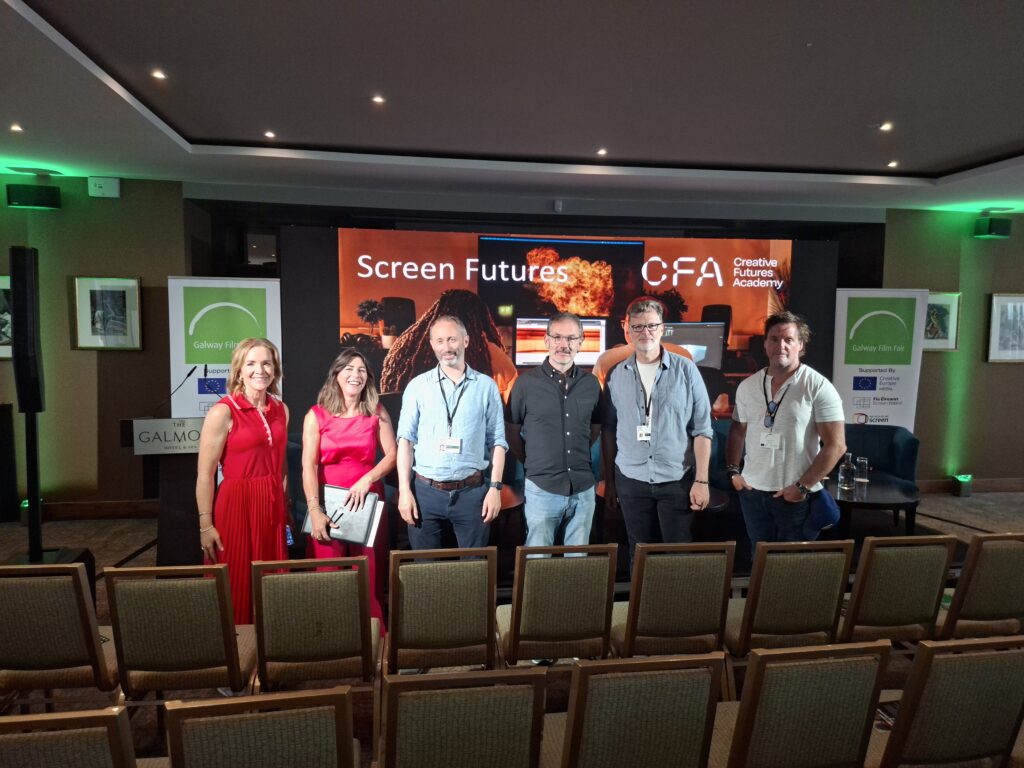

Creative Futures Academy brought together leading voices from Ireland’s screen and creative industries for Screen Futures – Creativity, Sustainability and Success in a Changing Screen Industry, a public panel discussion held on Saturday 11 July at the Galway Film Fleadh.
Hosted by Rónán Ó Muirthile, Dean of Engagement and Partnership at IADT, the conversation brought together John Norton (Head of Production, RedTed Media), Camille Donegan (CEO, Eirmersive), Kevin Fox (Writer & Producer), Niamh Costello (CEO, CREW) and Conn Holohan (Director, Centre for Creative Technologies, University of Galway) for a wide-ranging discussion on what it takes to build a sustainable creative career amid rapid technological and industry change.
A recurring theme was the need to keep storytelling, not tools, at the centre of creative work. Conn Holohan argued that the purpose of creative education is to move beyond skills and technology so that people can tell their stories: “You always have to bring it back to questions of story and purpose: why are you doing this? Because if there’s no reason behind it, it doesn’t matter what technology you use.”
Kevin Fox extended this into a wider reflection on the industry’s foundations, describing screen storytelling as fundamentally a way of conveying human connection and understanding, with technology, finance and distribution serving as tools to enhance that connection rather than drive it. He cautioned that one of the sector’s central challenges will be ensuring new tools support the story rather than dictate it — and that solving the industry’s gatekeeping problems in financing and distribution won’t come from technology alone:
“The industry, regardless of the future of technology, finance, or distribution, is a way to convey stories of human connection and emotion, a conduit for understanding one another. Everything else serves to facilitate the experience. One challenge in the future will be remembering that and building with all the tools on that foundation, while not losing the connection by allowing the tools and technology to overwhelm the story. Another challenge will be in the connection to the audience, as the financing and distribution aspects of the business determine who gets to make that connection. We need to advocate for the benefits of our work, and make partnerships with financing and distribution who understand it and understand how it can be rewarding for them as well. Those bifurcated goals are a problem we must solve, and won’t be solved purely by technology.”
Camille Donegan brought an XR perspective to the discussion, speaking to the opportunities immersive technology offers the wider screen sector: from new formats for audience engagement to the growth of the experience economy. Camille touched on the capabilities of immersive media and where storytelling is heading next, drawing on her work at Eirmersive supporting Ireland’s XR ecosystem. “Immersive venues like Outernet in London and Sphere in Las Vegas demonstrate how location-based experiences can unlock new revenue streams and strengthen the commercial viability of immersive content creation and storytelling”.
The panel took place against the backdrop of the Fleadh’s own Immersive Strand, which Eirmersive supported this year, showcasing eight VR works spanning themes from menopause and dementia to climate collapse and collective memory.
The panel didn’t shy away from artificial intelligence. Kevin Fox was direct about its limits as a creative shortcut: “If we continue to use AI that regurgitates the culture that exists, it is not going to change culture… learn the job of how to be a writer first before you touch AI and then maybe use it as a tool. Don’t use AI to learn how to write.”
John Norton added: “My overall sentiment about the entertainment business is that we are facing new challenges in the form of AI but the industry has always faced challenges. This time the challenges are now being experienced by the gatekeepers to the business also. New voices and new stories are finding their way to audiences as a result of new technology that allows those voices to be expressed and shared in a more organic and democratic way. Communities have built up around new creators and this model is changing the industry. Creators no longer need permission to create, they just need tenacity and originality. Their future is in their hands more than at any other time in the history of filmmaking.”
“AI by its definition creates a copy of original work and what we are seeing is that audiences no longer want the same old same old. They crave human connection stories told in new and original ways. This, in my opinion, is not a time to fret and worry about the future of film and storytelling, unless you are betting on AI to be that voice.”
Niamh Costello spoke to CREW’s work embedding entrepreneurship in creative education, building links between industry and universities so students “gain some of that experience before they complete their studies or graduate.” Reflecting afterwards on the discussion, she highlighted Kevin Fox’s reminder that it’s called “show business” for a reason: “At CREW, we’re passionate about supporting creative talent, but we’re equally focused on helping creative entrepreneurs build resilient, sustainable businesses. Creativity and commercial capability go hand in hand, and strengthening both is essential if Ireland’s screen sector is to thrive in an increasingly competitive global market.”
On visibility and audience connection, John Norton encouraged emerging filmmakers to think creatively about distribution and self-presentation: “I think people need to be imaginative and creative about where they share their stories… talk about your personal journey with the story as well. People are interested in going on that journey with you as you try to tell it.”
The event highlighted both the opportunities and challenges facing Ireland’s screen industries, from harnessing new technologies responsibly to developing sustainable creative careers. Across every topic discussed, the panel agreed that while the tools available to creators may continue to evolve, authentic storytelling, human connection and creative purpose will remain the foundations of the industry’s future.
CFA would like to thank Galway Film Fleadh, our host Rónán Ó Muirthile and panellists, and everyone who joined the discussion.