12 Jun 2026
IADT
90
16
DL929
1 year full-time
EU Fees: €7,000 / International Students: €16,000
Do you need to tell stories as part of your work in the creative and cultural industries? Do you want to make podcasts, write briefs or press releases, create short videos for media platforms? Are you interested in storytelling and narrative forms? Would you like to explore concepts around storytelling and narrative construction at a critical and creative level? Do you want to better engage an audience about your work? If any of these apply, then this MA is for you!
The MA in Media Narratives will explore all forms of visual, audio and literary production for the short form narrative, with an emphasis on traditional and experimental storytelling.
Underpinned by theories in Narrative Studies, the practice includes but is not limited to podcasts, short videos, short film, creative non-fiction (written and recorded), documentary, spoken word, photo-journalism, screencasts and blogs.
Combining the narrative strategies of more traditional media with the possibilities of new media, the course will encourage you to apply dexterity, experimentation and innovation to your content creation and production practice.
Our MA will equip you with the technical ability to navigate new media forms and explore their own expression in diverse ways in this creative space. It aims to help advance your career in the creative and cultural industries, specifically for those who produce, or are seeking to produce, content as part of their professional role. This could be a journalist who produces videos for online platforms; people working in cultural organisations such as galleries, theatres or museums who need to develop storytelling skills for a variety of communication platforms; those working in film, art, literary and theatre festivals who may be required to create content as part of their social media communications and online platforms; and / or creative professionals (writers; filmmakers; artists) who wish to develop professional skills in short-form narrative content creation.
By the end of the course, you will have a portfolio of work ready for publication, streaming and exhibition.
The MA runs for one calendar year full-time, beginning on the 21st of September 2026. Classes typically take place two days and one evening per week.

• Narrative Traditions, Theories + Concepts – delve into narrative theory as a tool of analysis for structure and form in a historical context.
• Narrative Genres – study short films, short stories, flash-fiction and podcasts.
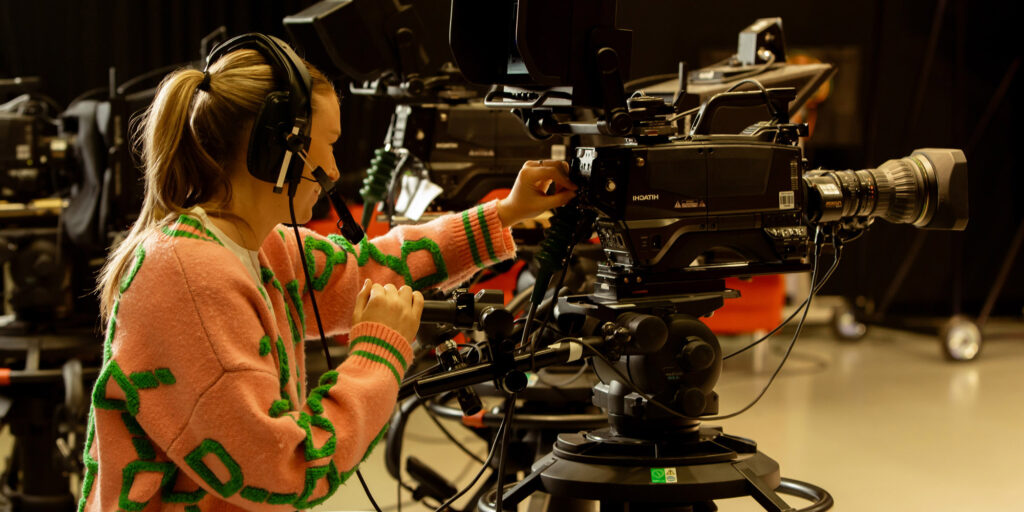
• Narrative Production Techniques – develop the grammar of film, television and media production, particularly questions of narrative, storytelling, framing, composition, movement, editing, sound and lighting.
• Non-fiction Narratives – explore creative non-fiction, micro-docs, folklore + spoken word, and ways in which these work as narrative forms and creative constructs.
• Creative Use of Archives – a workshop-based module to explore the potential offered in digitised archives for the creative practitioner.
• Screen Narratives + Methodologies – explore changes in narrative form and content in contemporary screen media; design and pitch an original creative project.
• Final Project + Portfolio – stages you will go through, from completing a piece of work to accessing an audience, providing a bridge from study to work and produce a project comprising a significant narrative production in your preferred medium together with a critical production report.
Graduates may work as a Content Writer and Editor, Video Content Specialist, Multimedia Co-Ordinator, Social Media Manager, Communications Officer, or in the Creative and Cultural Industries in video and podcast production.
Portfolio
It is not required to have a portfolio
Min Entry Requirements
Undergraduate qualification of 2nd Class Honours or higher at Honours Degree level. Some prior experience in a cognate discipline is desirable.
Applicants without an appropriate degree qualification may be considered provided they can demonstrate equivalent experience through our RPL (recognition of prior learning) process.