Archive of the Senses – an elective mobility for creative arts students from IADT and NCAD developed with CFA
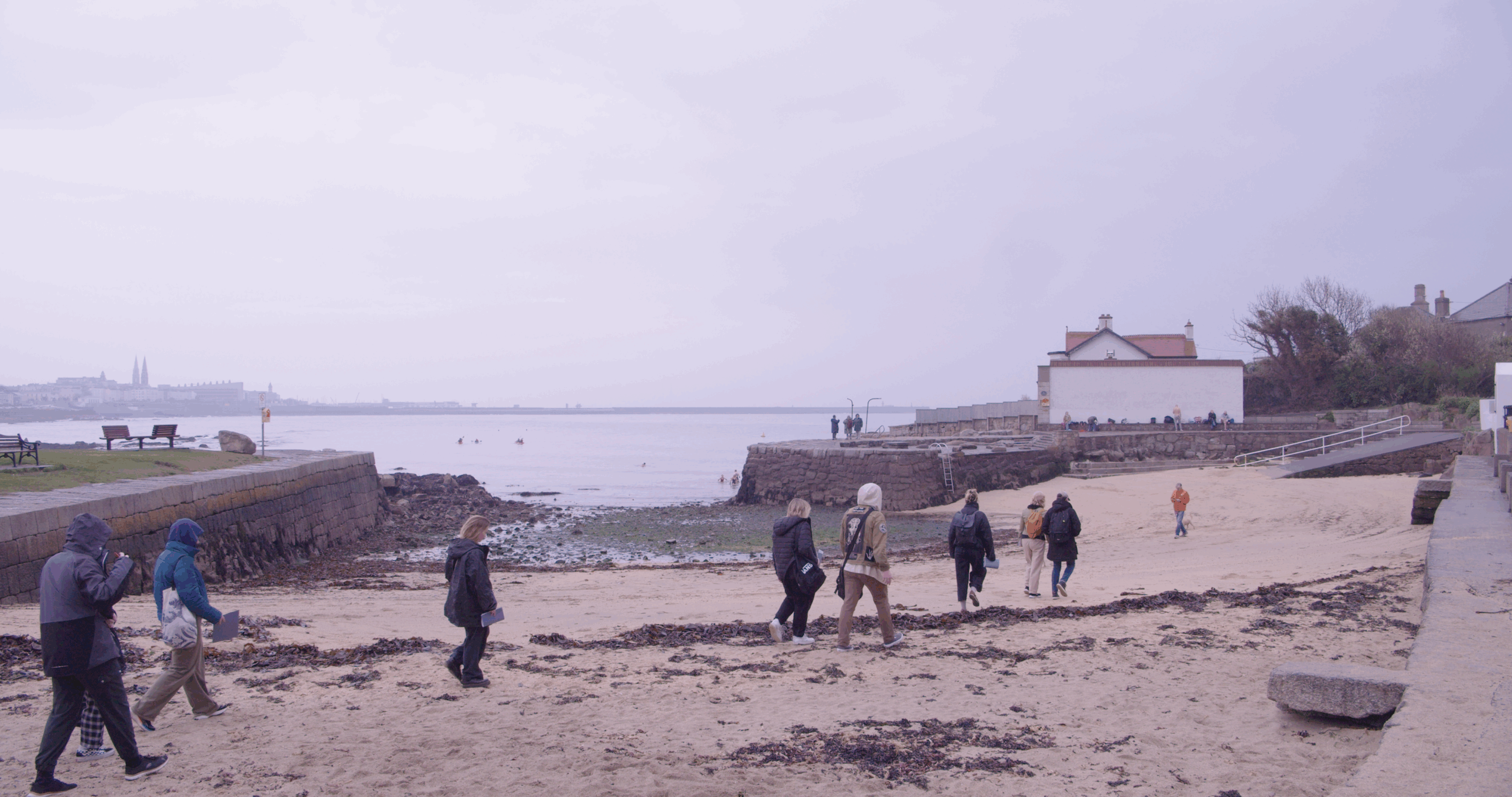
Archive of the Senses is a six-week elective module designed around walking as a creative practice and site-specific methodologies. Through the lenses of psychogeography and affect theory, students explore the sensory and emotional dimensions of places along Dublin Bay. The goal is to uncover local maritime histories and stories by engaging with maps, archives, and found objects, and to develop creative work in response. The module was supported by Creative Futures Academy (CFA) funding, enabling cross-institutional collaboration, materials provision, and staff time.
The case study for the Archives of the Senses module (funded as a CFA mobility elective that ran in Spring 2025) has been included in the inaugural HEA Education for Sustainable Design Case Studies Collection. Read more below.
This active module involves site visits, walks, seminars, readings, and independent learning through carefully structured activities, including: exploring industrial heritage and coastal environments at Dún Laoghaire’s West Pier, examining site, affect and atmosphere at the historic Dún Laoghaire Oratory, and investigating ecosystems, topography, walking-as-practice and culture through guided walks at Dalkey Quarry, and the seashore. Each session follows a structured approach combining preparatory materials, embodied site experience, and reflective discussion that connects local observation to broader creative practice contexts. These carefully selected sites—industrial, cultural, and natural—enable students to understand sustainability challenges as interconnected systems rather than isolated issues, developing the integrated problem-solving approaches central to ESD.
Students document their experiences through self-directed reflective notebooks that capture ongoing processes of site engagement, mapping, sensory observation, and creative experimentation. These notebooks can include walking exercises, drawings, found objects, photographs, written insights, emotional responses, conceptual mappings, and whatever combination of media works best for individual students. The documentation process itself becomes a professional skill, teaching students how to research, reflect, and develop ideas over time rather than rushing to finished products.
The module culminates in presentations where students contextualise their experience, share the development of their ideas, and articulate possible future directions for new creative works. This open-ended structure allows students to locate their work within their own emerging creative practices and reflect on the transferable value of the skills they have developed. Students are encouraged to consider how walking-based and ecologically attuned research methodologies might inform future creative projects, demonstrating their ability to integrate new approaches and points of view into existing practice.
This initiative embodies Education for Sustainable Development (ESD) principles through its pedagogical design and learning outcomes. The module employs action-orientated and transformative learning approaches, positioning walking as both method and subject of inquiry. Students develop critical UNESCO ESD competencies including systems thinking through examining interconnected relationships between urban development, coastal ecosystems, and cultural heritage; critical thinking through psychogeography and site analysis; collaboration through cross-institutional peer learning; and self-awareness through sustained reflective practice. The experiential methodology integrates problem-based learning as students investigate real heritage sites and environmental contexts, whilst inquiry-based approaches encourage students to frame their own research questions and creative responses. This learner-centred model supports students in developing the competencies, values, and skills needed for sustainable creative practice, preparing them as professionals who can work across environmental, cultural, and community contexts in ways that contribute to sustainable futures. This approach develops anticipatory thinking as students envision how their creative practice might contribute to sustainable futures, building capacity not just to understand sustainability challenges but to act as agents of change through their professional work.
Developed within the Creative Futures Academy’s (CFA) innovative elective framework which we designed, this cross-institutional module demonstrates how creative education can prepare practitioners who understand the relationship between place, community, heritage, and sustainable creative practice. The module builds professional competencies in environmental observation, heritage interpretation, and community and peer engagement whilst developing collaborative networks essential for careers in the evolving creative economy, where practitioners increasingly work across disciplines and with diverse community partners.
Third year undergraduate students from IADT and NCAD participated as equal collaborators in this cross-institutional initiative, building professional networks and transdisciplinary competencies essential for sustainable creative careers. The module’s emphasis on connection to land, community, water, and heritage through walking practice develops professional skills in community engagement, environmental stewardship, and place-based creative methodologies. Students actively led their environmental documentation processes whilst collaborating across disciplines, modelling the collaborative approaches increasingly valued in sustainable creative industries. External partnerships with local heritage sites and natural environments provide authentic contexts for professional development, whilst the peer-to-peer learning structure mirrors the collaborative networks that characterise successful sustainable creative practices and emerging green creative economies.
As a module within the CFA at IADT’s elective framework this module worked within the generic learning outcomes for the module which are:
The module employs structured walking as the primary pedagogical method, with each session combining embodied site experience, preparatory readings, and reflective discussion. From its conception, the module was designed with ESD as a core priority, ensuring students had meaningful opportunities to engage with their local but often unknown natural and cultural environments. This approach was grounded in a view of active and situated pedagogy that recognises that learning happens most effectively when students form personal, embodied connections to place and heritage. Students engage in sensory mapping exercises supported by contextual materials on psychogeography, maritime history, and creative research methodologies. The approach emphasises process, encouraging experimentation and documentation through diverse media. Tutors facilitate pre-walk briefings and post-walk reflections, helping students connect local observations to broader creative practice contexts. This experiential methodology develops students’ professional competencies in site-responsive research, community engagement, and reflective practice whilst building their capacity for self-directed creative inquiry.
Assessment centres on two interconnected elements: a reflective notebook documenting the student’s creative research process, and a final presentation contextualising their learning within their broader creative practice. The notebook captures ongoing processes of site engagement, sensory observation, and creative experimentation, with students self-directing format and content to include sketches, photographs, collected materials, written reflections, and conceptual mappings. The final presentation requires students to articulate how their walking-based research might inform future creative projects, demonstrating their ability to integrate new methodologies into existing practice. This assessment approach supports the module’s focus on professional development, evaluating students’ capacity to expand their creative toolkit whilst reflecting critically on their learning process.
Students reported expanded understanding of creative research methodologies and enhanced capacity for environmental observation and heritage interpretation. Interviews revealed lasting changes in their creative practice, incorporating walking-based and site-specific methodologies into ongoing projects. The cross-institutional model fostered meaningful collaborations, with participants maintaining professional connections beyond module completion. Students developed practical skills in working with heritage sites and environmental contexts, building competencies valued by cultural organisations and community partners. Faculty gained valuable experience in place-based pedagogy and cross-institutional collaboration. Working with colleagues across institutional departments (Art/Design/Psychology) led to an IADT team invitation (in partnership with DLR) to co-author a Creative Europe funding proposal on environmental literacy, well-being, and walking as creative practice with six EU HEIs, demonstrating the module’s potential for scaling innovative creative education approaches whilst contributing to sustainable cultural practice.
| Contributor(s) |
|
||||||||||
|---|---|---|---|---|---|---|---|---|---|---|---|
| Institution(s) and Partner Organisations |
|
||||||||||
| Discipline(s) |
|
||||||||||
| Programme(s) |
|
||||||||||
| Student Engagement | 11 (4 NCAD students; 7 IADT students) |